Claude Haiku 5.5 at work: six real jobs and what they cost
Support triage, document Q&A, CRM clean-up, subagents, browser agents and compaction, with the cost maths for each and the jobs to keep away from it.
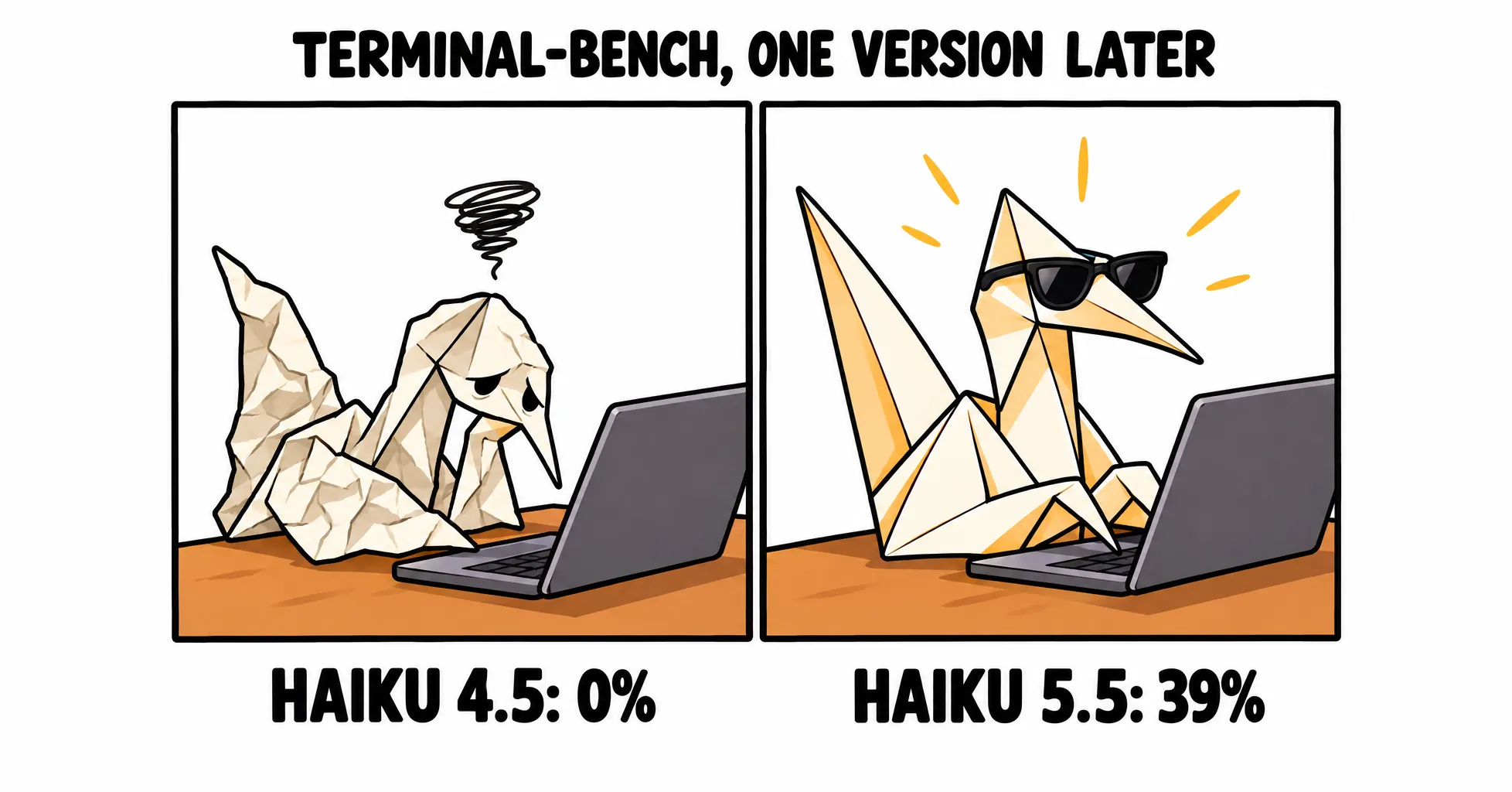
If you’re adding AI to a product, two questions decide most of the design. Which model goes where, and what will it cost at your volume? Anthropic’s Haiku 5.5 launch on 7 October changes both answers. This post skips the press release. It goes through the jobs where Haiku 5.5 now makes sense in a real product, what the companies testing it reported, and what each job costs at realistic volume.
Two numbers frame everything below. On prompts up to 100,000 tokens, Haiku 5.5 costs $0.10 per million input tokens and $0.50 per million output tokens. That’s a tenth of Haiku 4.5 and a twentieth of Sonnet 5.5. Above 100,000 tokens the price goes up five times. Anthropic’s blended estimate, after its new tokenizer uses a few more tokens per task, is about 75% cheaper than Haiku 4.5.
Every cost example uses the short-prompt rates and my own token assumptions, which I state each time. They ignore caching, retries and the tokenizer change, so treat them as orders of magnitude for planning, not quotes.
1. Support triage and live chat
The job. Read an incoming ticket or chat message, classify it, pull the order or account, draft a reply or route it to the right person. Customers are waiting, so speed matters as much as quality.
What a company reported. Asana ran Haiku 5.5 through the evals for its AI Teammates product, covering bug triage, project set-up and portfolio search. Against the model it uses today, Asana saw task completions over 30% faster and up to 2.5 times faster inference per agent turn. Anthropic also says Haiku 5.5 is its fastest model at standard speed.
What it costs. Take a support desk handling 50,000 tickets a month, with 3,000 tokens of ticket, history and policy going in and a 300-token triage note coming out. That’s about $22.50 a month on Haiku 5.5, $225 on Haiku 4.5 and $450 on Sonnet 5.5. Per ticket, Haiku 5.5 comes to under a twentieth of a cent.
What to measure in a pilot. Measure misroutes, not accuracy in general. A ticket sent to billing when it belonged to fraud costs far more than the model call, so track the cases where the label was wrong and a human had to move it.
2. Question answering over documents
The job. A user asks a specific question about one contract, report or filing, and the model answers from that document. It often runs on every page view, so the call count grows with traffic.
What companies reported. AlphaSense runs its Ask in Document feature about 8 million times a week. On 400 test queries, Haiku 5.5 scored 0.84 against Haiku 4.5’s 0.76, and AlphaSense called the gain statistically significant. Box reported an 11-point improvement over Haiku 4.5 at about half the latency, and named cost reports, financial summaries and weekly reviews as the work it would move.
What it costs. Assume 8 million calls a week at 8,000 tokens in and 300 out. These are my assumptions, not AlphaSense’s figures. That comes to about $7,600 a week on Haiku 5.5, against $76,000 on Haiku 4.5. At this volume the model choice is a finance decision as much as an engineering one.
What to measure in a pilot. Copy AlphaSense’s method. Build a fixed set of a few hundred real questions with agreed answers before you switch anything, and score both models on the same set. Without that set, “it feels better” is all you have.
3. CRM and data clean-up
The job. Go through thousands of records and flag the stale deal, the duplicate contact or the account with no owner. Each decision is small. The volume is what made it expensive before.
What a company reported. HubSpot tests smaller models on simulated portals with CRM tasks. Haiku 5.5 scored 92.8% averaged over three runs, the best HubSpot has seen on that suite. On one audit task, finding stale but ambiguous records, it was the fastest model tested, with the highest hit rate and the lowest false positive rate.
What it costs. A nightly sweep of 200,000 records at 1,500 tokens in and 100 out costs about $40 on Haiku 5.5, or roughly $1,200 a month if you run it every night. The same sweep on Haiku 4.5 is $400 a night. That difference decides whether a nightly audit is worth running at all.
What to measure in a pilot. False positives. A tool that flags 30% of good records as stale gets switched off by the sales team within a week. HubSpot measured this directly, and you should too.
4. Subagents under a bigger model
The job. A strong model plans the work and hands narrow lookups to cheaper helpers. Read this filing and return one number. Search this folder for the config. Summarise this log.
What companies reported. Rogo, which builds AI for finance, uses a Haiku 5.5 subagent to pull a single segment revenue line out of a 10-K while a bigger model builds the slide deck. Cognition added Haiku 5.5 as the helper model in Devin Fusion, with Opus 5.5 as the lead, and says Fusion holds a FrontierCode score of 66.2 while costing less and running faster.
What it costs. Say a research task sends 20 subagents to read 60,000 tokens each and return 500 tokens. That’s about $0.13 per task on Haiku 5.5 and $2.50 on Sonnet 5.5.
Watch the 100,000-token line here. A full 10-K is often longer than that. Twenty subagents reading 120,000 tokens each at the long-prompt rate cost about $1.23. Splitting each filing into two 60,000-token chunks and running 40 subagents costs about $0.25. Chunk your inputs.
What to measure in a pilot. Measure how often the lead model has to redo a subagent’s work. If it re-reads the filing itself, you pay twice.
The same pattern works in the other direction too. A popular Claude Code tip from @polydao is to run /advisor fable. Opus 5.5 does the work, and Fable 5.1 reads the session and steps in only before a plan, when the same error repeats, and before the task is called done. The expensive model stops weighing in on every step. Replies to the post point out that Fable uses the same weekly quota, so this changes where you spend your allowance rather than adding to it.

5. Browser agents for portals with no API
The job. Plenty of real work still happens in web portals that will never get an API. Insurance claim systems, supplier portals, government tax and customs forms, old internal admin panels. A browser agent can log in, fill the form and download the receipt.
What changed. Haiku 5.5 scores 72.4% on OSWorld 2.1 (offline subset), up from 15.7% for Haiku 4.5. Sonnet 5.5 scores 83.9%. Anthropic also added computer use and browser use to its Python and TypeScript SDKs in beta, and named Haiku 5.5 as the model it suits.
What it costs. A 30-step portal task, with about 8,000 tokens of screenshot and context per step and a 200-token action back, costs under three cents a run.
What to watch. A 72% benchmark score means a lot of runs still fail. Design for that. Have the agent stop and hand over to a person when a page doesn’t match what it expects, and give it read-only access until you’ve watched it work. If it will hold real logins, read my agent security brief first.

An unsupervised browser agent with admin logins. GIF via GIPHY.
6. Compaction and summaries in long agent sessions
The job. Long agent sessions fill their context window. Something has to summarise the history so the main model can keep working. Anthropic lists compaction as a target job for Haiku 5.5.
What it costs. Compacting an 80,000-token session into a 4,000-token summary costs about one cent on Haiku 5.5.
Anthropic also halved Sonnet 5.5’s cache-read price to $0.10 per million tokens, from $0.20. A long agent session rereads its cached context on every turn, so cache reads are often the largest line on the bill. Anthropic estimates Sonnet 5.5 is now about 20% cheaper on most agentic work. A Sonnet lead with Haiku handling compaction is now a much cheaper setup than it was last week.
Where Haiku 5.5 doesn’t belong
A take has been going around since the launch that Haiku now works like Sonnet, and Sonnet like Opus. For the jobs above, that’s roughly fair. For writing code, Anthropic’s own table says otherwise:
| Benchmark | Haiku 5.5 | Sonnet 5.5 |
|---|---|---|
| GDPval-AA v2.1, knowledge work (Elo) | 1620 | 1840 |
| OSWorld 2.1, computer use | 72.4% | 83.9% |
| Terminal-Bench 4.0, agentic coding | 39.2% | 70.6% |

Keep it away from three kinds of work:
- Planning and writing code across many files. Terminal-Bench is 39% against 71%. Anthropic’s launch page says Sonnet and Opus remain the better choice here.
- Long inputs by default. Above 100,000 tokens the price goes up five times. Chunk documents, or check whether Sonnet’s cached reads come out cheaper for your workload.
- Decisions nobody reviews. Refunds, credit limits, anything with legal weight. A cheap model makes cheap mistakes faster. Put a person or a stronger model on the final call.
Here’s how I’d route a typical product today:
| Job | Model | Why |
|---|---|---|
| Support triage, classification, routing | Haiku 5.5 | Fast, cheap, narrow decisions |
| Q&A over one or a few documents | Haiku 5.5 | High volume, short prompts |
| CRM and data clean-up | Haiku 5.5 | Volume, with false positives tracked |
| Lookups and summaries for a lead model | Haiku 5.5 | Subagent work, chunked under 100k |
| Browser tasks on portals with no API | Haiku 5.5, with a human fallback | Many short steps |
| Planning, coding, multi-step reasoning | Sonnet 5.5 or Opus 5.5 | Haiku is far behind on coding |
| The final call on high-stakes output | Opus 5.5 or a person | Mistakes cost more than tokens |
How I’d run a two-week pilot
- Pick one job from the list above. Choose the one with the highest volume and the clearest right answer, usually triage or document Q&A.
- Build the test set first. Collect 300 to 500 real inputs with agreed answers. AlphaSense used 400.
- Run in shadow mode. Haiku 5.5 runs next to your current model on live traffic, but users only see the current model’s output. Log both.
- Measure the right things. Track the error that costs you money (misroutes, false positives), p95 latency, and the real bill per thousand calls. Measure the bill after the tokenizer change, not from the price table.
- Switch with a fallback. Move traffic over, and send anything the model is unsure about to the bigger model or a person.

GIF via GIPHY.
You may not have to pay for the pilot
Anthropic is giving subscribers a monthly Claude Platform API credit, rolling out this week. Max 5x gets $100, Max 20x gets $200, and Team plans get up to $500 pooled across users. The credit works with any model, and the Help Center article has the details. At Haiku 5.5’s short-prompt rate, $100 covers a billion input tokens, which is more than most pilots use.
For startups, Anthropic expanded Claude Startups on 6 October. Companies founded in the last five years, or funded in the last two, can apply. The package is a free year of Claude Team for up to five Premium seats, a one-time $1,000 API credit, and partner discounts that Anthropic values at up to $45,000 at list price. Most teams won’t use every offer, so the real value is lower.
Two more things worth knowing this week
GPT-6 now runs on every ChatGPT account. OpenAI’s GPT-6 for everyone went out on 7 October, with free and Go accounts moving to GPT-6 Luna from 8 October. The product change that matters is Intelligent UI. ChatGPT can now answer with charts, forms and small working tools, such as a bill splitter, inside the chat. If your product is a single-purpose calculator or form, your users can now get a rough version from ChatGPT in one prompt. The pricing angle matters too. Haiku 5.5’s short-prompt API rates are the same as GPT-6 Luna’s, which I listed in the DevDay post, and on every row where Anthropic includes Luna, Haiku 5.5 scores higher. Those are Anthropic’s tests, so run your own.
Marketing teams can make launch videos with Opus 5.5. Raphael Aubry spent three days making product videos with Opus 5.5 in Claude Code, without After Effects or a video model. Opus writes a web page where a seek(t) function draws the exact frame for time t, a headless browser captures every frame, and ffmpeg joins them. His process advice is the useful part. Review four still frames before rendering, find the music drop by measuring bass energy, and have Opus score contact sheets of its own frames. His own launch video took five versions, and he is promoting his product, Howseen, in the same post. The skill is open source at howseen-ai/claude-motion-design.
The short version
Haiku 5.5 doesn’t replace your best model. It makes a set of jobs cheap enough to run on every ticket, every document and every record, where before you had to sample or skip them. Those are the jobs I’d start with, in this order: triage, document Q&A, data clean-up, then subagents. If you want help picking the first one, get in touch.
Questions
What is Claude Haiku 5.5 good for?
Short, high-volume, well-defined jobs: support triage, answering questions over a few documents, cleaning CRM records, lookups for a bigger model, browser tasks on portals with no API, and compacting long agent sessions. Asana, HubSpot, AlphaSense, Box, Rogo and Cognition all reported results on jobs like these at launch.
Should I replace Sonnet with Haiku 5.5?
Not for planning or writing code. On Terminal-Bench 4.0 Haiku 5.5 scores 39% against Sonnet 5.5’s 71%, and Anthropic itself says Sonnet and Opus remain the better choice for complex agentic coding. Use Haiku 5.5 under Sonnet or Opus as a subagent, and keep the bigger model as the lead.
How much does Claude Haiku 5.5 cost?
For prompts up to 100,000 tokens it costs $0.10 per million input tokens and $0.50 per million output tokens. Above 100,000 tokens the rates are five times higher, at $0.50 and $2.50. Anthropic estimates the average saving against Haiku 4.5 at about 75%.
Checked on 8 October 2026. Customer results are as Anthropic published them on the launch page, and benchmark scores are Anthropic’s and OpenAI’s own. I haven’t reproduced either. Cost examples are my own arithmetic on list prices with the token counts stated, ignoring caching, retries and the tokenizer change. The Claude Code tips come from posts on X, not from Anthropic.