AI Week: the model is becoming the least important part of the stack
Issue 4 · week of 16 August 2026
This week’s theme: a model is only one part of the product now. The editor, the API bill, the hardware and the place where the code runs can matter just as much.
I checked lab announcements, model cards, API documentation and reporting. It was not the only AI news. Made by Google shipped a new Pixel line, River AI announced a $1.1 billion round, and a new Windows zero-day appeared. I left those out of the main thread because they do not change the engineering choice as much as the four items below.
1. SpaceX put the coding agent and the model under one roof
SpaceX closed its reported $60 billion all-stock acquisition of Cursor during the week. TechCrunch reported the closing, following the original deal report from CNBC. The $60 billion figure and the all-stock structure come from those reports. I did not inspect a filing directly.
Cursor is where developers choose models and let them edit a repository. Grok is a model and, through Grok Bot, a service for long-running agents with their own computer. If one owner controls both surfaces, the subscription can determine the model, the agent’s access to your files and the compute underneath it.
A vertically integrated stack may be faster or cheaper. It also creates a larger dependency than an API endpoint. If you build around a coding agent, check where prompts, repository context and generated patches can go when the vendor changes the product.
I am being careful with the corporate name. Some coverage calls the merged entity SpaceXAI and describes the Grok Bot subscription as a partnership with Cursor. The acquisition reports support common ownership. They do not prove every product integration or the long-term corporate structure.
2. The local model wave is now a deployment option
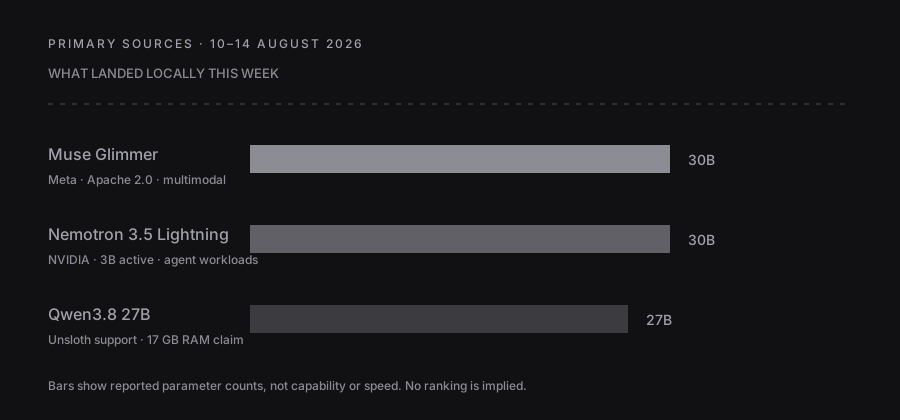
Three releases and one tooling update made local inference look more practical. Meta released Muse Glimmer, a 30B multimodal open model under Apache 2.0. NVIDIA put Nemotron 3.5 Lightning on Ollama. NVIDIA describes it as a 30B model with 3B active parameters for long-running agent work. Unsloth documented support for Qwen3.8 27B, including its claim that a quantized version can run in 17 GB of RAM.
The parameter counts and memory figure are vendor claims. They help with rough planning, but they do not show that the models are equally capable or fast. What changed for me is the range of local options: a multimodal model, a sparse agent model and a 27B model that may fit on a developer’s machine.
I would test a local fallback for more than the API savings. It can keep source code and customer data inside your boundary, survive an outage and make a narrow tool call cheap enough to run continuously. You also inherit quantization bugs, model-serving work and upgrades. Local inference gives you control, but it does not give you reliability for free.
3. Frontier releases are competing on the bill and the schedule
Google released Gemini 3.7 Flash on 13 August, only three weeks after the previous Flash release. Google reports improvements on coding, browser and automation benchmarks. Those are Google’s own numbers from its own evaluation setup. The short release cycle matters more to me: a model name may not stay current for long.
DeepSeek’s 13 August change log gives builders more to work with. V4 Pro reached general availability, added native Responses API support, offered low, high and max thinking effort, and published new benchmark numbers. DeepSeek also said peak and off-peak pricing would begin on 16 August, with off-peak prices set at half the peak price.
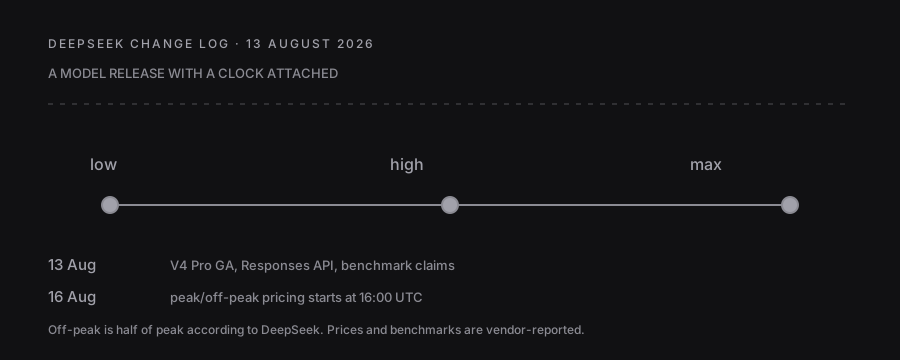
That pricing model changes how I would schedule work. A batch job, coding sweep or embedding refresh can wait for cheaper hours. A user-facing request usually cannot. Compare cost per successful task, with the latency and availability your product needs, rather than dollars per million tokens alone.
Before switching a production workload, I would test low effort for routine requests, high effort for normal agent work and a local model for private or repetitive operations. Use the same tasks each time. Record retries, tool errors, wall-clock time and total cost. A model that costs less per token can still cost more if it needs two extra attempts.
4. Provenance moved from a policy page into the output
Anthropic’s updated Claude marking documentation says newer Claude models launched in the EU carry machine-readable text watermarks under the EU AI Act transparency requirements. Anthropic says the marking and C2PA provenance for files also apply globally across its products and cloud partners.
The part I care about is what happens after generation. If your product stores, edits or republishes model output, preserve the metadata where you can and decide what happens when a customer asks you to remove it. Do not promise that a detector can prove authorship. The support page documents Anthropic’s mechanism, not an independent test of its accuracy.
5. The news I am not carrying forward
I am still following the Taiwan AI-assisted cyberattack reports. The exact framework names and the claim that one prompt defeated the safety checks came from reporting, not from a primary government document I could verify. Issue 3 already covers the better-sourced agent-security thread, so I am not adding a fifth incident story on weaker evidence.
I left GLM-5.3 benchmark claims out too. The research note found secondary coverage but no current primary release to inspect. A benchmark number without the model version, harness and prompt policy does not tell me much.
I led with the SpaceX and Cursor acquisition because it changes a developer’s dependencies. Made by Google 2026 was the bigger hardware story. Pixel’s on-device features matter, especially ASL Live Transcribe, but the event was mainly a phone launch. I would rather keep this issue about deployment choices than turn that announcement into a larger AI argument.
6. What I would do on Monday
Write down the vendor dependencies in your agent architecture. Include the editor, model router, storage, identity provider and compute region. A change of ownership can affect all of them without changing your application code.
Then create a small local-model lane. Use synthetic or already-cleared code, run ten representative tasks, and measure success, latency, memory, tool-call reliability and review time. Keep it as a fallback even if the hosted model wins.
Make model choice depend on task cost. Use low thinking effort for routine calls, reserve max effort for tasks where it pays back, and schedule bulk work around the price window when the product can tolerate delay.
Store provenance beside generated artifacts. A model name, version, provider, timestamp and prompt policy are more useful than a vague “AI-generated” label when a customer reports a bad result six months later.
Do not call a model safe because its demo stayed inside a sandbox. Issue 3’s incident reports are a better reminder. This week’s launches spread the system across more vendors and machines, which makes the boundary harder to see.
Sources
Primary:
- Meta introduces Muse Glimmer
- Muse Glimmer on Ollama
- Nemotron 3.5 Lightning on Ollama
- Gemini 3.7 Flash, Google
- DeepSeek V4 Pro change log
- Claude output marking, Anthropic
- Grok Bot, xAI
- Qwen3.8 local support, Unsloth
Reporting and analysis:
- SpaceX closes Cursor acquisition, TechCrunch
- SpaceX and Cursor deal, CNBC
- DeepSeek V4 Pro coverage, Quartz
- Made by Google 2026, TechCrunch
The cover is an original generated image. The two diagrams are original redrawings of the linked product documentation and model claims. The parameter counts, benchmarks and pricing terms remain vendor-reported unless stated otherwise.
If I got something wrong, tell me and I will correct it in the next issue.